
Baby-Proofing Your Home: A Room-by-Room Guide (2026)
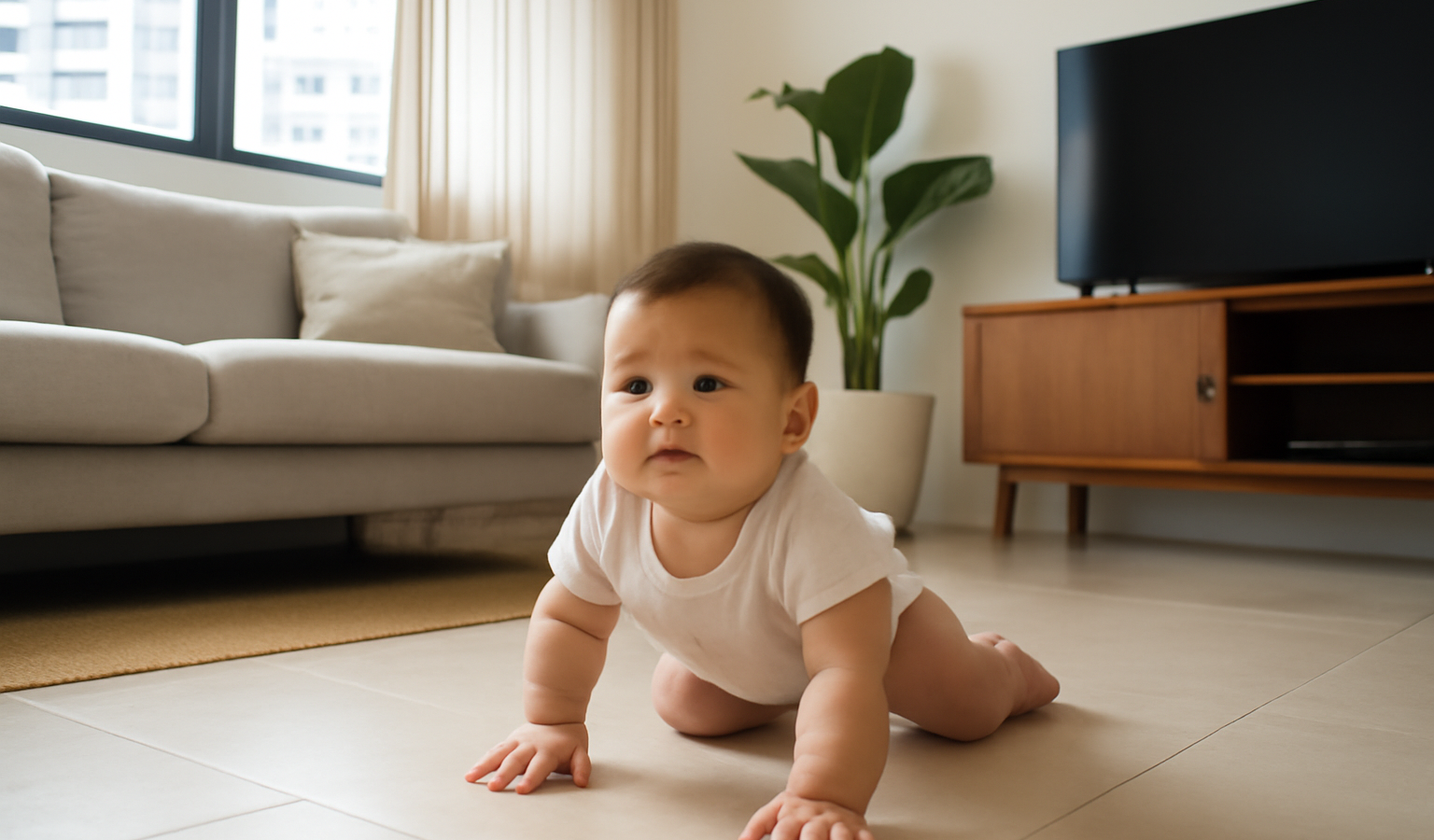
Somewhere between month five and month eight, your home quietly changes species. The flat you designed for adults — cables tucked behind consoles, plants on the floor, cleaning products under the sink — becomes an obstacle course explored by someone with no fear, endless curiosity and a compulsion to put everything in their mouth. Baby-proofing isn’t about buying every gadget in the catalogue; it’s a room-by-room audit done from your child’s height, staged to their mobility. Here’s how to do it for a typical Singapore flat.
Start with the crawl test
Before buying anything, get on hands and knees and crawl each room slowly. You’ll immediately see what adult-height walkthroughs miss: dangling blind cords, charging cables at mouth level, sharp table corners at head height, coins under the sofa, the wobble in that bookshelf. Take photos as you go — that’s your shopping and fixing list, and it will be shorter and more accurate than any generic checklist.
Then stage the work. Pre-crawling, focus on sleep safety and anchoring. Once crawling starts, floors, sockets and low cupboards matter. Once pulling-to-stand and climbing begin — the most dangerous stage — furniture stability and window access dominate.
Windows and balconies: the non-negotiable first job
In high-rise Singapore, this is priority one. Work through it methodically:
- Restrict what opens. Check that openable window sections latch securely, and consider restrictors that limit how far windows open. If you have casement windows a child could push wide, treat them with particular respect.
- Audit your grilles. Grilles help, but check the gap spacing, and confirm any openable grille sections lock — an unlatched grille door is a false sense of security. If your grilles are old or missing, replacing or adding them is a worthwhile spend.
- Remove the climbing frame. The most common failure isn’t the window — it’s the sofa, bed, storage box or chair sitting under it. Keep climbable furniture away from all windows and balcony parapets, permanently.
- Never trust insect screens. They keep out mosquitoes, not toddlers, and give way under almost no force.
- Balconies: nothing climbable near the parapet, ever, and supervise all balcony time. Check that railing gaps can’t admit a determined toddler.
Living room: anchors, corners and cords
Furniture tip-over is the big preventable injury here. Chests of drawers, bookshelves and TVs become climbing equipment the moment a child can pull to stand. Anchor tall and tip-prone furniture to the wall with anti-tip straps or brackets — they cost little and fit in minutes. Wall-mounting the TV, or strapping it to the console, removes one of the heaviest hazards in the room; if you’re drilling into an HDB wall for it anyway, our guide to mounting a TV on an HDB wall covers doing it properly.
Beyond anchoring: corner guards on coffee tables (or retire the sharp-edged table for a couple of years), cable management so cords can’t be pulled or chewed, blind cords shortened or cleated out of reach, and small objects — batteries and coins above all — kept off low surfaces. Button batteries deserve special paranoia: they cause severe internal injuries if swallowed, so check remotes and gadgets have secured battery compartments.
Kitchen: your most hazardous room
The simplest strategy is exclusion — a safety gate at the kitchen entrance keeps the whole room out of bounds during cooking. Within the kitchen:
- Chemicals up high. Move detergents, dishwasher tablets and cleaning sprays from under the sink to a high cabinet, or fit reliable cabinet locks. Brightly coloured pods look like sweets to a toddler.
- Stove discipline. Back burners first, handles turned inward, and no dangling appliance cords (kettle cords are the classic).
- Sharp things. Knives and scissors in a locked drawer or high block, not a counter block at grabbing height.
- The oven and hob front get hot enough to burn small palms — a hob guard or strict gate policy covers it.
Bathroom, bedroom and service yard
Bathroom: never leave standing water — young children can drown in very shallow water, so empty pails and basins immediately after use (a habit worth building anyway for mosquito prevention). Set your water heater so tap water can’t scald, add a non-slip mat, and keep medicines and toiletries locked or high. A toilet lid lock is worthwhile once your child is mobile.
Bedroom: follow safe-sleep basics — a firm mattress in a cot that meets safety standards, no pillows, loose blankets or soft toys for infants, and the cot positioned away from windows, blind cords and radiating heat. If you’re setting up the room from scratch, our guide to a kids’ room setup on a budget covers safe, affordable choices that grow with the child.
Service yard: often forgotten, frequently hazardous — washing machine doors (keep closed and use child locks), detergents, mops in buckets of water, and sometimes an openable window. Give it the same audit as the kitchen.
Gates, guards and what you can skip
Worth buying for most homes: a well-fitted safety gate or two (kitchen and any steps), furniture anchors, cabinet locks for chemical storage, corner guards, and door slam stoppers. Nice-to-have depending on your flat: hob guards, toilet locks, window restrictors. Usually skippable: elaborate padded floor everything, gadget-heavy monitors sold on fear, and single-purpose gizmos solving problems a habit fixes better. Keep a small, well-stocked first aid kit and emergency numbers handy — our guide to a home emergency kit in Singapore covers what belongs in it.
One tool-related note: anchoring furniture and fitting gates takes a drill, a level and the right plugs for concrete walls. If your toolbox is thin, see our list of essential tools every home needs — you’ll use them for the next decade of childhood repairs anyway.
Habits that do the heavy lifting
Hardware only covers half the risk; the other half is household habits, which cost nothing:
- The hot drinks rule: never carry a hot drink over or near the baby, and keep mugs away from table edges — scalds from pulled-down cups are a depressingly common toddler injury.
- Floor discipline: nothing smaller than a ping-pong ball on the floor in crawl zones; a quick nightly sweep catches coins, beads and stray small toys before morning does.
- Doors and fingers: the whole household closes doors slowly and checks for trailing hands — slam stoppers help, but habits prevent.
- Kitchen timing: the most dangerous minutes are when cooking and child-minding overlap. Gate the kitchen or hand the child to someone rather than multitasking over a hot wok.
- Learn basic first aid. An infant and child first-aid course — choking response above all — turns the worst five minutes of parenthood into something you’re actually trained for.
Brief everyone who cares for the child at home — grandparents and helpers included — on the same rules, because a system one adult ignores is a system that doesn’t exist.
Re-audit as they grow
Baby-proofing decays. The child who couldn’t reach the counter in March can reach it by June; the cabinet lock that defeated a one-year-old is a puzzle a two-year-old solves. Re-run the crawl test (now a “toddler-eye audit”) every few months, and update as new skills appear: climbing means re-checking windows and furniture; opening doors means re-checking the gate strategy and the front door itself.
The bottom line
Baby-proofing a Singapore flat comes down to a few high-impact moves done early: secure windows and remove anything climbable near them, anchor tip-prone furniture and the TV, lock away chemicals and sharps, gate the kitchen, and never leave standing water. Do the hands-and-knees audit, stage the work to your child’s mobility, and repeat it every few months — the hazards move as fast as the child does.
Frequently asked questions
When should I start baby-proofing?
Before your baby crawls — typically by six months, earlier than most parents expect. Anchoring furniture, covering sockets and securing windows are best done in one weekend before mobility arrives.
Are window grilles enough to keep a child safe?
Grilles help but aren't automatically childproof — check gap widths, make sure any openable sections latch securely, and keep beds, sofas and boxes away from windows so there's nothing to climb. Insect screens offer no protection at all.
Do I need to cover power sockets in Singapore?
Singapore's three-pin sockets have internal shutters that block the live holes, which reduces risk, but socket covers and keeping appliances unplugged and cords out of reach are still sensible for curious toddlers who mimic plugging things in.
What's the most commonly missed baby-proofing hazard?
Furniture and TV tip-overs. Chests of drawers, bookshelves and TVs on low consoles become climbing frames to a toddler — anchor them with anti-tip straps, which are inexpensive and take minutes to fit.
More in Moving & Home Setup
See all
Cheap Storage Options in Singapore (2026)
Looking for cheap storage in Singapore? Learn to declutter first, weigh self-storage costs and find budget alternatives like box storage, shared and…

A Realistic Home Cleaning Schedule (2026)
A realistic home cleaning schedule for busy Singapore households: daily 10-minute resets, weekly rotations, monthly deep tasks and when to outsource.

Move or Renovate? How to Decide (2026)
Move or renovate? A practical framework for Singapore homeowners: compare true costs, disruption, what renovation can and cannot fix, and when moving…