
Window Grilles: Types, Rules & Costs (2026)
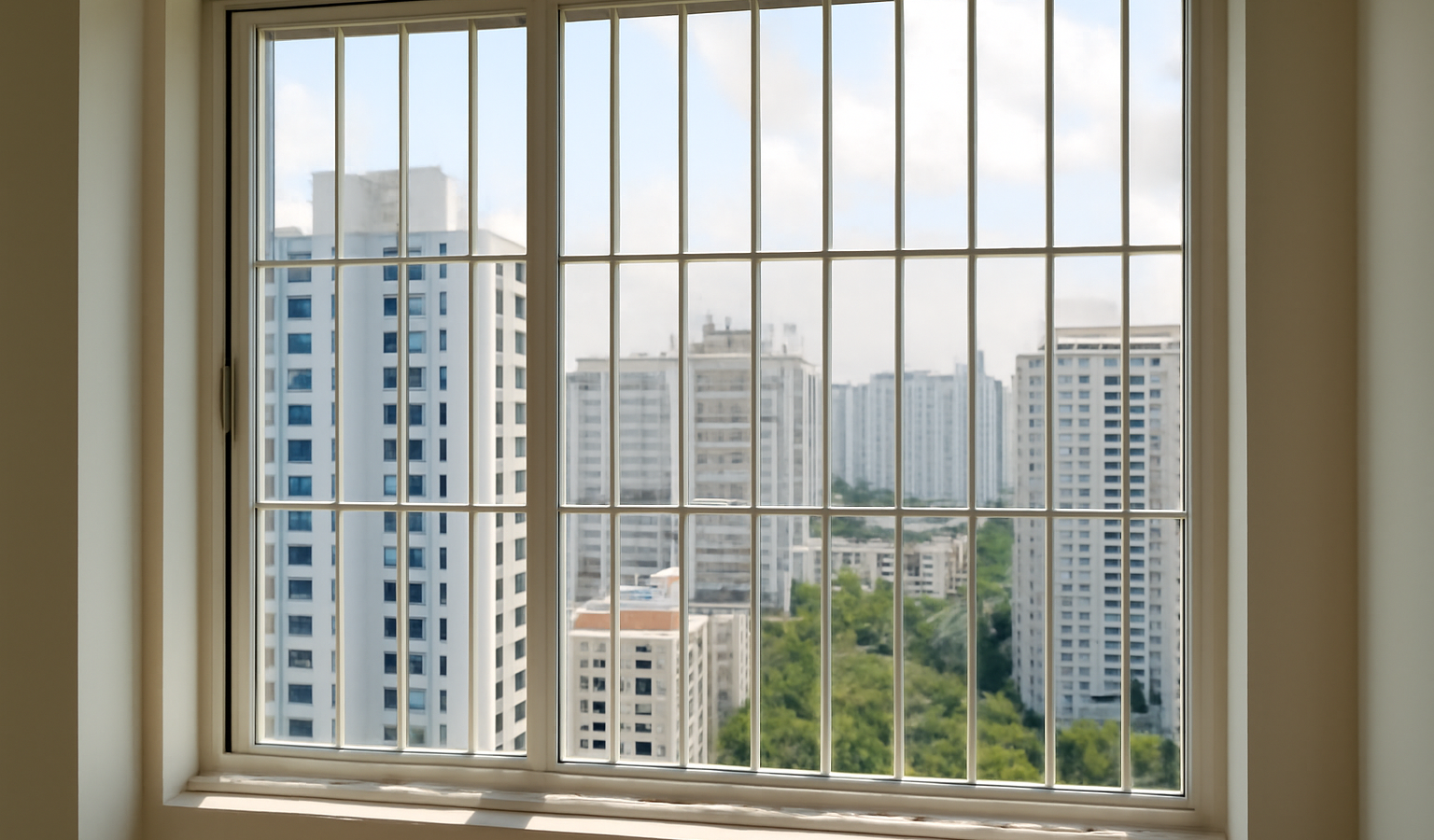
Living ten storeys up changes how you think about an open window. Grilles are one of those unglamorous decisions that quietly shape daily life in a Singapore flat — they determine whether you can leave windows open when you’re out, whether your toddler or cat can be near a window unsupervised, and even how easily your aircon technician can service the condenser. Choose well and you’ll never think about them again; choose badly and you’re stuck looking through prison bars for a decade.
This guide walks through the main grille types sold in Singapore, the estate rules you need to check before ordering, and what a realistic budget looks like in 2026.
Why grilles are still worth having
Modern condos and newer BTO blocks sometimes skip grilles entirely for a cleaner look, and that’s a legitimate choice. But grilles earn their keep in three situations.
- Child and pet safety. Windows are the single biggest fall hazard in a high-rise home. Grilles let you keep windows open for ventilation without worrying about a climbing child or a cat on the ledge.
- Security. Ground-floor and low-floor units, and units next to common corridors, benefit from a physical barrier — especially for windows you leave open at night.
- Everyday convenience. With grilles in place you can leave windows open while you’re at work, which keeps the flat aired out in Singapore’s humidity without inviting birds, or worse, in.
Fixed aluminium grilles
The traditional option: welded or riveted aluminium bars in a fixed frame, screwed into the window opening. They’re the cheapest type, the most secure, and essentially maintenance-free apart from an occasional wipe-down.
The trade-offs are real, though. Fixed grilles permanently block access through the window, which matters for cleaning the outside of the glass, retrieving laundry poles, and — critically — servicing an aircon condenser mounted on a ledge behind them. If a fixed grille covers your condenser access, expect servicing and future replacement to become harder and potentially more expensive. Most fabricators can build in a lockable openable section, and it’s usually worth paying for one.
Openable and sliding grilles
Openable (swing) grilles work like a gate: the panel is hinged and secured with a lock or latch, so you get full access to the window when you need it and a closed barrier the rest of the time. Sliding grilles run on tracks, mirroring the movement of sliding windows, and suit wide openings and service yards where a swing panel would get in the way.
Both cost somewhat more than fixed grilles because of the extra hardware, and both introduce moving parts — tracks collect grime and hinges eventually sag, so budget a little time for occasional cleaning and adjustment. The flexibility is usually worth it, particularly for kitchen windows and service yards where you’re reaching out regularly.
Invisible grilles
Invisible grilles have become the default choice in many newer flats and condos. Instead of bars, thin stainless steel cables are tensioned vertically or horizontally across the opening at close spacing, anchored to slim aluminium tracks. From a few metres away they nearly disappear, which is the whole point: unblocked views and daylight, with fall protection intact.
A few things to understand before buying:
- They’re a safety barrier, not a security barrier. Cables can be cut with tools far more easily than solid bars, so on low floors they don’t replace security grilles.
- Cable spacing and tension matter. Reputable installers follow tight spacing for child safety and tension each cable to specification. Ask what spacing is quoted and whether the system has been load-tested.
- They need occasional checks. Cables can lose tension over the years. Many suppliers offer a warranty and re-tensioning service — ask about both.
Expect invisible grilles to cost more than basic aluminium grilles for the same opening, with pricing usually quoted per foot or per panel.
Check your estate’s facade rules first
This is the step people skip, and it’s the one that causes grief. HDB blocks and town councils typically maintain approved grille designs and colours to keep the block facade uniform — particularly for windows visible from outside. Install an unapproved design or colour and you can be asked to remove and redo it at your own cost. The rules vary by estate and by block age, so the safe move is simple: check with your town council or HDB what design and colour are approved for your block before you order anything.
Condo owners face the same issue through the MCST — most managements have by-laws specifying permitted grille types, often favouring invisible grilles precisely because they don’t alter the facade’s appearance. Separately, window safety itself is regulated: HDB and BCA require windows to be kept in good working order, and older casement windows have rivet-retrofit requirements. If your grille installer needs to touch the windows themselves, make sure any such work respects those rules. If you’re doing grilles as part of a larger renovation, fold this into your HDB renovation permit checklist so nothing slips through.
Don’t forget the aircon condenser
If your condenser sits on a ledge or bracket outside a window, grille design directly affects servicing. Technicians need to reach the unit safely for cleaning, gas top-ups and eventual replacement — a fully fixed grille across that opening can turn a routine job into an expensive one requiring grille removal or gondola access.
The standard solution is an openable, lockable section aligned with the condenser. Tell your fabricator exactly where the unit sits (or will sit, if you’re planning a new aircon installation) before they measure. Getting the sequence right — aircon bracket first, then grilles — saves rework, and it keeps future servicing costs predictable.
What grilles cost in 2026
Pricing depends on window size, grille type, material thickness, the number of openable sections and how many windows you’re doing at once. As a rough guide only — quotes vary widely, so verify current pricing with two or three fabricators:
- Fixed or sliding aluminium grilles: often starting in the low hundreds of dollars per standard window, rising with size and design complexity.
- Openable/swing grilles: typically a modest premium over fixed for the hinges and locking hardware.
- Invisible grilles: usually priced per foot; a standard window commonly costs more than an equivalent aluminium grille, and large balcony openings add up quickly.
- Whole flat: doing every window and the service yard in one job often lands somewhere in the low thousands, with invisible grilles at the higher end.
Bundling grilles into a renovation package can be cheaper than ordering standalone, but compare against a direct specialist quote — grille specialists sometimes beat the contractor’s marked-up price. For context on how this fits into a wider budget, see our guide to renovation costs by flat type.
How to choose for your home
A quick decision framework:
- High floor, young kids or pets, view matters: invisible grilles on living areas and bedrooms.
- Low floor or corridor-facing windows: solid aluminium grilles for security, openable where you need access.
- Kitchen and service yard: sliding or openable grilles for laundry and ventilation access.
- Aircon ledge windows: whatever type you pick, include a lockable openable section for the technician.
Mixing types across the flat is completely normal — most homes end up with invisible grilles in front and practical aluminium at the back.
The bottom line
Grilles are a modest line item that touches safety, security and daily convenience for years. Confirm your estate’s approved designs and colours before ordering, match the grille type to each window’s job rather than buying one type throughout, plan openable access for the aircon condenser, and treat any quoted prices as a starting point to compare against two or three fabricators. Get those four things right and this is one renovation decision you’ll never revisit. For the bigger picture on planning works in your flat, browse our renovation and services guides.
Planning grilles as part of a bigger reno? Tell us what you need below and we’ll match you with vetted renovation contractors for quotes.
Frequently asked questions
Do I need HDB approval to install window grilles?
Grille installation within your flat generally doesn't need an HDB renovation permit by itself, but the design and colour usually must match what your town council or HDB has approved for the block's facade. Always check the approved specification for your estate before ordering.
Are invisible grilles safe for children?
Properly installed invisible grilles with cables tensioned and spaced to the supplier's safety specification are widely used for child safety in high-rise homes. They are a fall-prevention barrier, not a play structure, so supervision still matters and cables should be checked for tension periodically.
How much do window grilles cost in Singapore?
As a rough guide, basic fixed or sliding aluminium grilles often start in the low hundreds of dollars per window, while invisible grilles typically cost more per opening. A whole flat commonly lands somewhere in the low thousands, so get itemised quotes and verify current pricing.
Can I install grilles over the aircon ledge?
Often yes, and it's common for safety during condenser servicing, but the grille usually needs an openable section so technicians can access the unit. Check your town council's rules and tell your contractor where the condenser sits before fabrication.
Get renovation quotes
Share your renovation plans and we’ll help you get quotes from interior-design firms. Free, no obligation.
More in Renovation & Services
See all
Budget Interior Design Tips for Your Home (2026)
Budget interior design tips for Singapore homes: where to save or splurge, loose furniture vs carpentry, paint and lighting wins, and phasing…

Home Office Renovation Ideas & Setup (2026)
Home office renovation ideas for Singapore flats: dedicated room or nook, ergonomics, lighting, power and data points, acoustics and smart storage for…

Resale Flat Interior Design Ideas (2026)
Practical resale flat interior design ideas for older HDB homes: when to refresh or hack, handle dated tiles, keep charm and choose…