
Turning One Room Into a Guest Room + Home Office
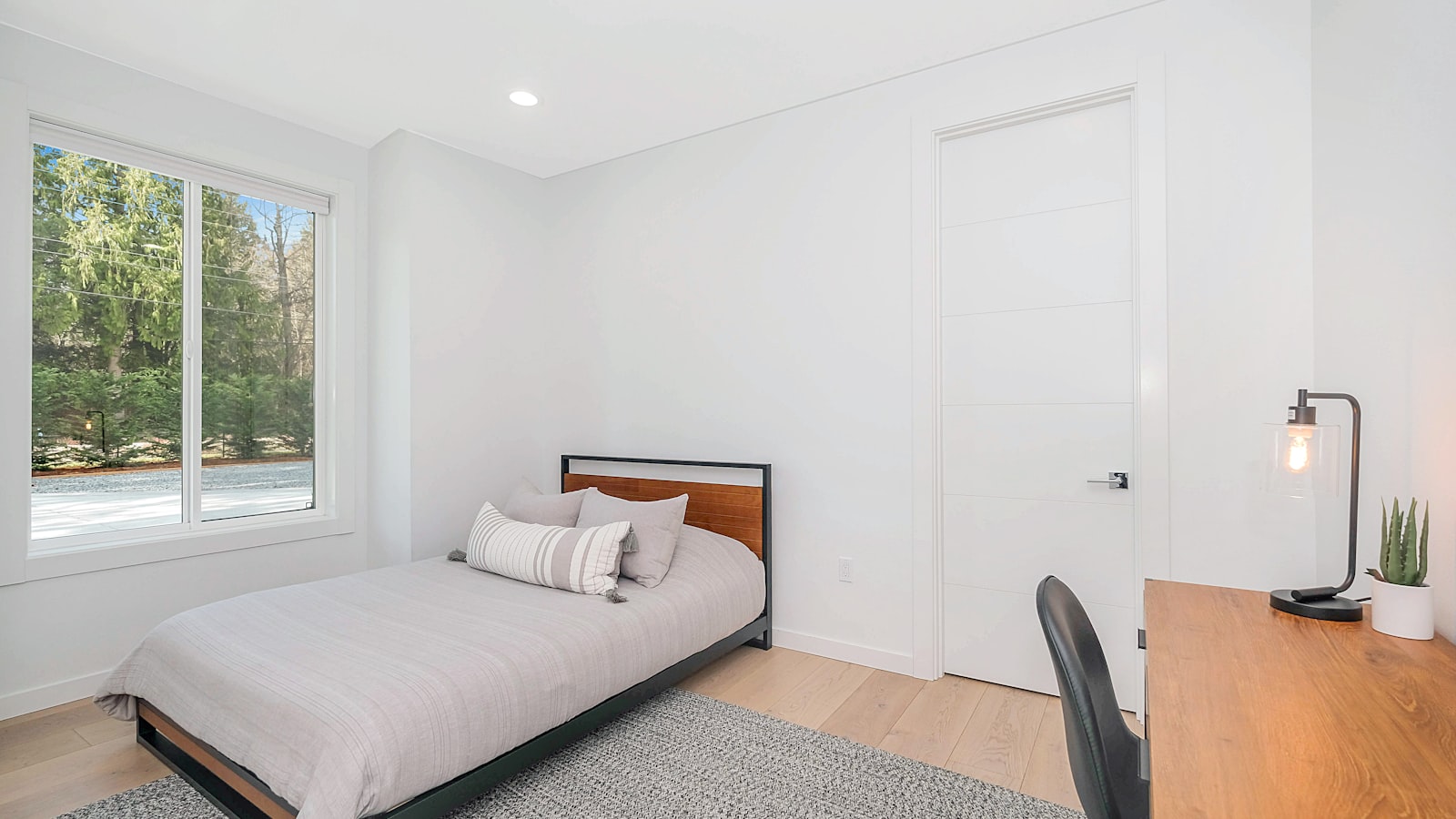
Here’s the honest arithmetic nobody does before furnishing the spare room: if your in-laws visit twice a year for a week each, that room is a guest room for 14 nights and an office for the other 351 days. Yet plenty of people plan it the other way around — a permanent queen bed hogging nine square metres, with a sad desk wedged into the leftover corner where the owner works every single day. Getting the combo right starts with admitting which function actually earns its floor space.
Start with the honest ratio
A dual-purpose room fails when both functions are compromised equally. It succeeds when you rank them. For most households the split is roughly 90% office, 10% guest room — so the office gets first pick of the light, the layout and the budget, and the guest function is engineered to appear on demand and vanish afterwards.
Before buying anything, answer two questions. How many guest nights did you actually host last year — not hope to host, but did? And who are the guests — parents in their sixties who need a proper mattress and some privacy, or friends crashing after dinner who are happy on a futon? A retiree staying three weeks justifies real bed spending; the occasional overnight friend does not. Every choice below flows from those answers.
Choosing the bed: four options, four trade-offs
The bed decision is where most of the money and floor space goes, so it deserves a proper comparison. Rough 2026 price guides below — verify current figures before buying.
| Option | Rough cost | Best for | Watch out for |
|---|---|---|---|
| Sofa bed | S$600–2,500 | Regular guests; doubling as seating | Cheap fold-out mechanisms sleep badly; good ones cost real money |
| Daybed | S$400–1,500 | Occasional single guests; reading corner daily | Single-width only; sits permanently in the room |
| Murphy / wall bed | S$2,000–5,000 | Frequent guests plus a real mattress, in a tight room | Highest cost; needs wall works; you lose that wall daily |
| Floor futon | S$150–500 | Rare guests; minimal budget and zero footprint | Less comfortable for older guests; needs storage space when folded |
The futon is underrated: for a couple of visits a year, a quality foldable mattress stored in the wardrobe costs a tenth of a wall bed and steals no space from the office. The murphy bed is the opposite bet — expensive, but the only option that gives guests a genuine full-size mattress while returning the entire floor to you on Monday morning. Sofa beds sit in between and earn their keep best when you also want somewhere to sit and think away from the desk. If the room is small enough that every piece must multitask, our roundup of space-saving furniture for small homes covers more dual-purpose options.
Layout in a typical HDB bedroom
A common HDB bedroom gives you roughly 3m by 3m of usable space in general terms — enough for both functions only if the geometry is planned. The desk takes priority position: along or beside the window, ideally with the desk perpendicular to the glass so daylight falls across your work without putting the window behind your screen (glare) or behind you (silhouette on calls). A 120cm desk is comfortable for a monitor setup and still leaves wall for everything else.
Then test the bed maths. Whatever folds out must land with at least 60cm of walking clearance on one side — measure the sofa bed’s extended depth or the futon’s footprint against your floor plan before you buy, not after. Keep the wardrobe door swing and the room door swing out of the fold-out zone. If numbers get tight, remember the guest bed only needs clearance on guest nights; the desk chair needs its pull-back space every day. For the desk zone itself — monitor height, cable runs, chair clearance — our guide to a work-from-home desk setup in a small flat goes into detail.
Zoning: make it read as two spaces
Even in nine square metres, light zoning stops the room feeling like a bed showroom with a desk in it. A rug under the daybed or fold-out zone visually fences off the “rest” area from the “work” area. An open-backed shelving unit placed perpendicular to the wall works as a low divider that stores books and files on the office side and softens the sleeping side — without blocking light the way a solid partition would.
Colour and lighting do quiet zoning work too: keep the desk wall calm and functional, and let the guest side carry the softer textiles. When a guest arrives, a few thirty-second changes — cable tidy closed, chair pushed in, laptop away — flip the room’s identity convincingly.
Storage: where the guest kit lives
The combo room dies the day guest bedding starts living on the desk chair. Give the guest kit — spare sheets, pillows, blanket, towels — one permanent, enclosed home:
- Vacuum-compression bags shrink a full bedding set to a quarter of its size for the wardrobe top shelf — and in Singapore’s humidity, keep a desiccant pack inside.
- A storage ottoman or bench at the foot of the daybed holds bedding and gives guests somewhere to put a suitcase.
- Under-daybed drawers use the dead space beneath the mattress.
Add a luggage zone to your mental plan too: a visiting couple’s suitcase needs about half a square metre of floor for a week, so know in advance which corner surrenders it.
Video calls, lighting and acoustics
If you take calls in this room daily, design the camera’s view deliberately. Orient the desk so the webcam faces shelving, art or a plain wall — not the bed, which reads as unprofessional however tidy it is. Light your face from the front: window light works by day, and a small lamp behind the monitor fills in for evening calls far better than the ceiling light, which casts downward shadows.
Acoustics improve as a free side effect of the guest function. Curtains, a rug, cushions and a fabric daybed all absorb echo, so your voice sounds warmer on calls than in a bare-walled room. Layer the lighting for both uses: a focused task lamp at the desk, plus a warm bedside-height lamp the guest can reach — nobody should have to cross a dark unfamiliar room to find the switch.
Keep it working as an office every day
The last discipline is protecting the daily function. Don’t downgrade the chair to make the room look more like a bedroom — you sit in it eight hours a day, and our guide to choosing an office chair for home explains where the money matters. Keep a hard rule that guest items return to storage the morning after checkout, and resist the drift where the room becomes general household overflow: a combo room has two jobs, and “storeroom” is not the third. If you’re still furnishing the rest of the flat, our furniture and homeware guides cover every room at every budget.
A ten-minute conversion test is a good benchmark. If turning office into guest room takes longer than that — moving boxes, hunting for sheets, dismantling cable runs — simplify until it doesn’t, because friction is what makes people stop bothering.
The bottom line
A guest room and home office can share one small room happily, but only with an honest hierarchy: the office earns the light, the layout and the ergonomic spending, while the guest function is built to deploy fast and disappear faster. Match the bed to your real guest count — futon or daybed for occasional visitors, sofa bed or murphy bed for regulars — check fold-out clearances against the actual floor plan, and give the guest kit a permanent enclosed home. Do that, and you get a genuinely good office 351 days a year and a genuinely welcoming guest room the other 14, which is exactly the right way round.
Frequently asked questions
What is the best bed for a guest room home office combo?
It depends on guest frequency. For a few visits a year, a folding floor futon or a daybed that doubles as reading seating is the cheapest, least intrusive option. For monthly guests or long stays, a good sofa bed or a murphy bed protects both sleep quality and your daily desk space — at a higher cost.
How much does a murphy bed cost in Singapore?
As a rough 2026 guide, expect around S$2,000–5,000 for a wall bed including installation, with custom carpentry versions at the higher end. That compares with roughly S$600–2,500 for a decent sofa bed and S$150–500 for a quality floor futon, so it only makes sense if guests come often or the room is very tight.
Can a 3m by 3m HDB bedroom fit both an office and a guest bed?
Yes, with discipline. A 120cm desk along the window wall, a single daybed or folded futon against the opposite wall, and a slim shelving unit will fit with walking room to spare. A permanent queen bed plus a desk, however, leaves almost no circulation space — which is exactly why fold-away options exist.
How do I make a guest room office look professional on video calls?
Face the desk so the camera sees a tidy wall or shelving rather than the bed, put your face towards the window or add a lamp behind the screen for even lighting, and add soft furnishings — a rug, curtains, cushions — which double as acoustic damping so your voice sounds less echoey.
More in Furniture & Homeware
See all
Storage Ottomans & Benches: A Buying Guide
A storage ottoman or bench adds hidden storage and seating in small SG flats. Our buying guide covers types, sizes, materials, lids…

How to Measure for Curtains (2026)
How to measure curtains for Singapore homes: rod and track width, drop options, fullness ratio and day-and-night layering, all in cm and…

How to Measure a Room for Furniture (2026)
Learn how to measure a room for furniture step by step: length, width, doorways, delivery access, power points and walkways, plus a…