
TV Console Buying Guide: Size, Storage & Cable Mess
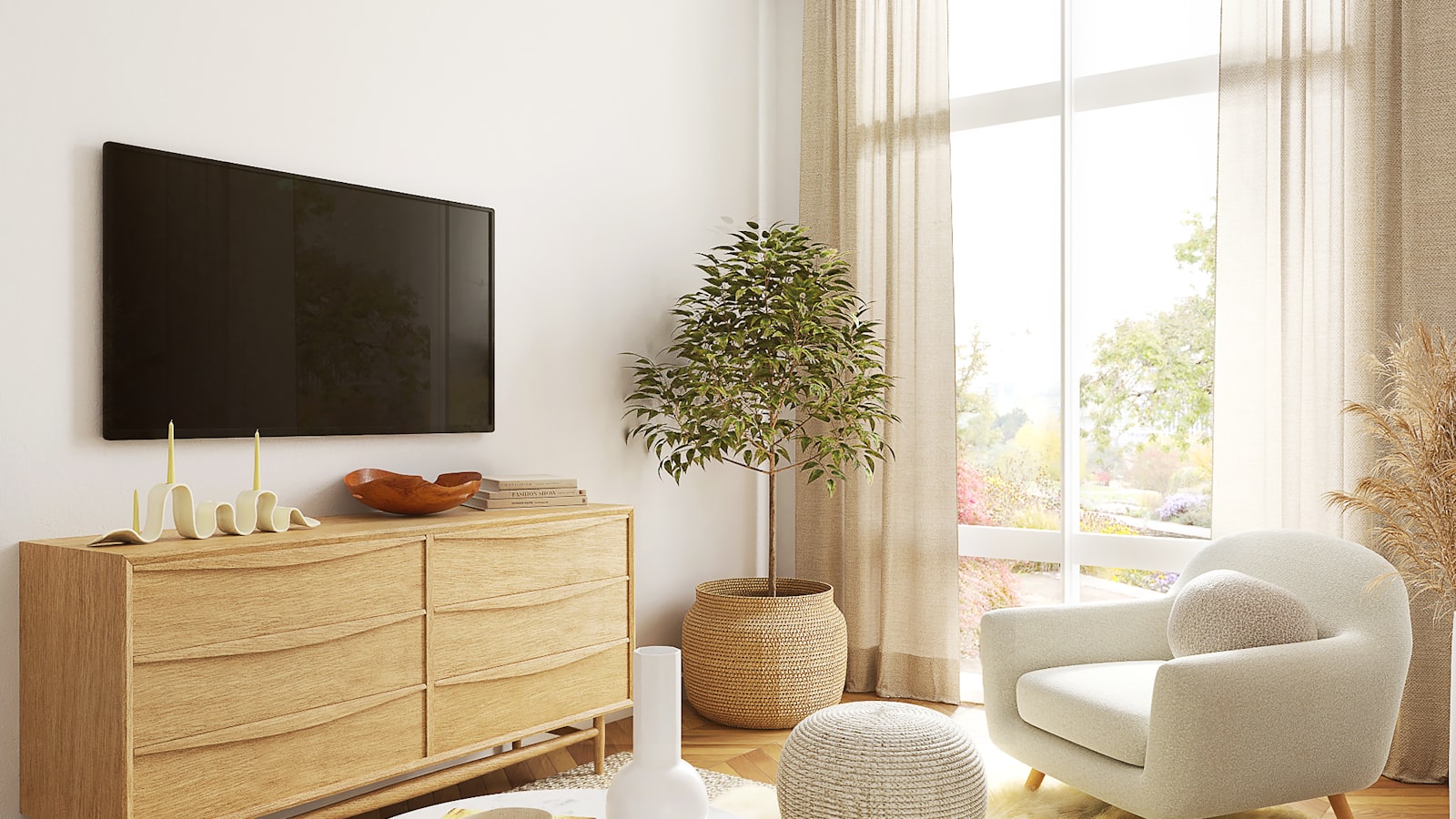
Walk through any furniture showroom and the TV consoles blur into one long parade of laminate. Yet the wrong console is one of the most common furniture regrets in Singapore homes: too short for the screen, too shallow for the set-top box, and within a month the cables behind it look like a plate of mee goreng. The fix is deciding a few things before you shop — the sizing maths, the storage mix and the cable plan. Here’s the whole checklist.
Start with the width maths
A TV’s advertised size is its diagonal, not its width, and that difference trips up plenty of buyers. As a rough guide, a 55-inch TV is about 1.2 metres wide and a 65-inch set is around 1.45 metres. The console should be wider than the TV — ideally with at least 15 to 25 centimetres of clear surface on each side — so the screen doesn’t overhang the furniture and the whole arrangement looks anchored rather than balanced on a ledge.
If you haven’t bought the TV yet, settle the screen size first, because it drives everything else: seating distance, console width, even how the wall feels. Our guide to choosing the right TV size for your living room covers the viewing-distance maths. Then check depth. Most consoles run 35 to 45 centimetres deep, and a narrow HDB living room may only take the shallower end comfortably once you allow walking space in front of it.
Get the height right for how you actually sit
The comfortable rule is that the centre of the screen should sit at or slightly below your seated eye level. For most sofas, that puts the middle of the TV somewhere around 95 to 105 centimetres off the floor — which, working backwards, is why the majority of consoles sold here stand between 40 and 55 centimetres tall. The bigger the TV, the lower the console wants to be.
Too high is the more common mistake. A tall sideboard pressed into console duty forces everyone to tilt their heads upward, front-row-of-the-cinema style, and it gets genuinely tiring over a two-hour film. If you plan to wall-mount the TV instead, the console’s height stops mattering for viewing and becomes a question of proportion and storage — a freedom worth using.
Storage: open shelves, doors or drawers
Before choosing a storage layout, list what will actually live with the TV: a set-top box, a streaming stick or game console, a soundbar, controllers, remotes, perhaps the router. Each storage format has a job. Open shelves keep electronics ventilated and let infrared remotes work without opening anything — game consoles in particular run warm and shouldn’t be sealed into a cupboard. Closed doors hide visual clutter and keep out the dust that settles quickly in Singapore, especially with windows open. Drawers are the unsung heroes for small things: remotes, spare batteries, cables and the manuals nobody reads.
The best consoles mix all three — an open shelf or two for powered devices, a cupboard for the ugly stuff, a drawer for the tiny stuff. If you fall for a fully closed design, check whether the doors are mesh, fabric or glass, which still pass remote signals and some airflow, or accept that doors stay open on game night.
The cable mess, solved before it starts
Cable chaos isn’t a tidiness failure; it’s a planning failure, and it’s cheapest to fix at buying time. First, count your plugs — TV, soundbar, set-top box, game console and router add up to five or six — and check whether the wall behind the console has enough power points, or budget for a quality extension strip that can live inside the unit. Second, look for cable-management features on the console itself: grommet holes in the back panel, a gap between the top and the wall, or a fully open back.
At setup, three cheap habits keep things tidy permanently: velcro ties to bundle each device’s slack, a small label on every plug so you’re never tracing cables during a fault, and leaving a little service loop so you can pull a device forward without unplugging everything. If audio is part of the plan, decide the speaker wiring at the same time — our comparison of soundbars versus speaker setups explains what each option means for cabling.
Materials and build quality
Most affordable consoles are laminated particleboard or MDF, and that’s fine — but quality varies enormously within the category. Press down on the shelves in the showroom: a long, thin shelf that flexes under your hand will sag under a loaded soundbar within a year. Inspect the edge banding, the strip sealing the raw board edges; peeling edges are how furniture starts dying in a humid climate. Plywood carcasses and solid wood cost more but cope better with Singapore’s humidity, which matters if the console sits near a window you keep open.
Check the stated weight rating for the top surface too — a large TV plus a soundbar is heavier than it looks. And work every door and drawer before paying, because hinges and runners are what fail first on cheap units.
Floor-standing, floating or full media wall
A standard floor-standing console is the default for good reason: no drilling, easy to reposition, easy to resell. A wall-mounted floating console looks lighter, frees the floor for a robot vacuum and visually enlarges a small room — but it must go into solid wall with proper anchors, and some internal walls in HDB flats are hollow partitions that need the right fixings, so check what you’re drilling into before committing. The third route is a carpentered media or feature wall that integrates the TV, storage and lighting into one built-in: polished and seamless, but costlier and permanent, so it’s a decision best made during renovation rather than after.
Whichever you choose, compose the whole wall, not just the unit — our HDB living room layout guide covers how the TV wall anchors everything else in the room.
Buying it: measure twice, carry once
Before you pay, measure the wall space — and then measure the journey: the lift door, the corridor turns, your front door. Fully assembled consoles are rigid, long and surprisingly awkward in an HDB lift lobby. Flat-packed units solve the delivery problem and cost less, at the price of an evening with an Allen key. Don’t overlook the second-hand market either: consoles are among the best-value used furniture around, because so many are sold nearly new after moves and renovations. For furnishing the rest of the room around it, browse our furniture and homeware guides.
The bottom line
A good console is wider than your TV with margin to spare, puts the centre of the screen near seated eye level, mixes open and closed storage to suit the devices you actually own, and has its power points and cable routes planned before delivery day. Get those four things right and the cable mess simply never happens — the console disappears into the background and quietly does its job for a decade. Buy on measurements, not showroom charm.
Frequently asked questions
How much wider should a TV console be than the TV?
As a rule of thumb, at least 15–25 cm of console on each side of the set. A 55-inch TV is roughly 1.2 m wide, so a console around 1.4–1.6 m looks anchored rather than precarious.
What is the ideal TV console height?
Low enough that the centre of the screen sits at or slightly below your seated eye level — for most sofas that means a console between roughly 40 and 55 cm tall, with bigger TVs wanting the lower end.
Do I still need a console if I wall-mount the TV?
Usually yes — your set-top box, game console, soundbar and remotes still need a home near the screen. A slimmer unit or a floating console works well under a wall-mounted TV.
How do I stop the cables becoming a mess?
Check the wall has enough power points or house a quality extension strip inside the console, choose a unit with grommet holes or an open back, then bundle slack with velcro ties and label every plug.
More in Furniture & Homeware
See all
Storage Ottomans & Benches: A Buying Guide
A storage ottoman or bench adds hidden storage and seating in small SG flats. Our buying guide covers types, sizes, materials, lids…

How to Measure for Curtains (2026)
How to measure curtains for Singapore homes: rod and track width, drop options, fullness ratio and day-and-night layering, all in cm and…

How to Measure a Room for Furniture (2026)
Learn how to measure a room for furniture step by step: length, width, doorways, delivery access, power points and walkways, plus a…