
Living in Sengkang: A Neighbourhood Guide (2026)

Twenty-five years ago, Sengkang was mostly farmland and fishing villages along the Punggol and Serangoon rivers. Today it’s one of Singapore’s largest and youngest new towns — a place where playgrounds outnumber coffee shops of the old-school kind, and where double prams are as common on the LRT as briefcases. If you’re considering renting or buying in the north-east, this guide covers what living in Sengkang is really like, from the commute to the riverside, and who the town fits best.
A young town built for young families
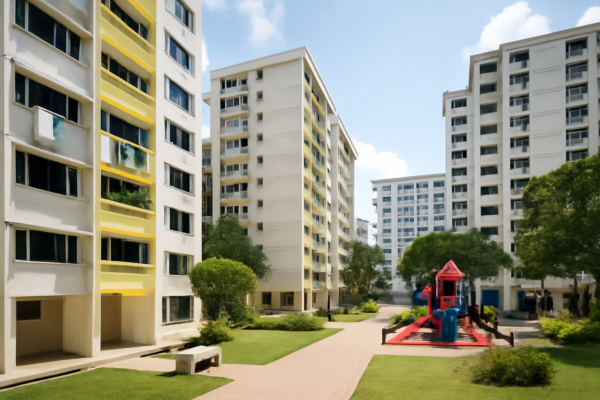
Sengkang was developed by HDB from the late 1990s onwards, and it wears its youth openly. Blocks are tall and modern, precincts are built around courtyards and playgrounds, and the demographic skews heavily towards young couples and families with school-age children. The town’s name comes from a road named after a prosperous harbour, a nod to the area’s river-port past, and pockets of that heritage survive in street names like Anchorvale, Compassvale, Rivervale and Fernvale — the four main neighbourhoods you’ll see in every listing.
The practical upshot of all that youth: childcare centres, preschools, primary schools and enrichment options are everywhere, tuition and paediatric clinics fill the neighbourhood centres, and weekend life revolves around parks, malls and community facilities rather than nightlife. If that’s your season of life, Sengkang is built for you.
Transport: MRT, LRT loops and the honest commute
Sengkang MRT station sits at the heart of the town on the North East Line, stacked with the bus interchange and Compass One mall. The line runs directly to Serangoon (interchange to the Circle Line), Little India, Chinatown and HarbourFront, which makes trips to the city fringe straightforward and one-seat.
The distinctive layer here is the LRT. Two automated loops — the east loop through Compassvale and Rivervale, and the west loop through Anchorvale and Fernvale — circle the residential neighbourhoods and feed them into the MRT and interchange. The LRT is genuinely useful for daily errands and school runs, but be honest about the arithmetic when choosing a flat: an address deep in a loop adds a transfer and 10 to 15 minutes each way versus a block near the MRT itself.
All in, expect roughly 30 to 45 minutes door to door to the CBD by train for most addresses. Drivers use the TPE and KPE, which put the airport and the city within easy reach outside peak hours. It’s a longer commute than central towns — that’s the core trade you make for newer, more affordable flats.
Compass One and daily amenities
Compass One, directly above the MRT, is the town’s anchor mall — supermarkets, a library, food courts, enrichment centres, clinics and the everyday retail mix that handles most household needs. Around it, the town centre adds banks, a community club and government service touchpoints.
Beyond the centre, each neighbourhood has its own smaller mall or neighbourhood centre — the Fernvale and Anchorvale sides have their own retail hubs — plus coffee shops and minimarts at the block level. The hawker scene is younger and more food-court flavoured than in mature towns; purists still cross to Serangoon, Hougang or Kovan for old-school stalls. Healthcare is a genuine strength: Sengkang General Hospital and its community hospital campus opened in 2018 on the Anchorvale side, giving residents a full acute hospital within the town — rare for a new town, and reassuring for families and older parents moving in.
Riverside parks and recreation
Sengkang’s geography between two rivers is its quiet lifestyle perk. Sengkang Riverside Park spreads along the Punggol river with wetlands, a floating island and shaded cycling paths, and it connects into the park connector network that runs along both the Punggol and Serangoon rivers. From most parts of town you can get onto a waterfront path and cycle to Punggol’s Waterway or towards Buangkok with barely a traffic light.
Add the Sengkang sports complex with its pools and stadium, the Anchorvale community club’s facilities, and playgrounds and fitness corners in nearly every precinct, and outdoor family life is well catered for. It isn’t manicured-destination greenery like a city park — it’s everyday, useable green space, which arguably matters more.
The housing stock: new, newer, newest
Almost everything in Sengkang is post-2000, and much of it is considerably newer. That means long remaining leases across the board, modern layouts, lifts on every floor and precincts designed around families. Recent BTO launches have continued to add stock, particularly on the Fernvale and Anchorvale sides, so the resale pipeline keeps refreshing as projects pass their minimum occupation period — worth understanding if you’re buying, since newly-MOP flats often hit the market in waves. Our explainer on HDB MOP rules and what they mean for buyers and sellers covers how that cycle works.
Executive condominiums and private condos cluster near the LRT stations and along the rivers, giving upgraders options without leaving the town. Flat sizes and layouts are typical of their era — efficient rather than generous — so if you’re chasing maximum floor area, older towns’ larger flats may tempt you instead. If you’re weighing a fresh BTO ballot against buying resale in Sengkang, our comparison of BTO versus resale HDB walks through the wait-time and pricing trade-offs.
Renting and buying: what to expect
Sengkang’s pricing proposition is straightforward: more flat, newer flat, for less money than central mature towns — in exchange for a longer commute. As a rough guide, rents and resale prices for equivalent flat types sit below estates like Toa Payoh, Queenstown or Bishan, though well-located newer flats near the MRT have narrowed the gap in recent years; always verify current transacted figures before you offer.
For renters, the sweet spot is often a newer flat near an LRT stop, where you trade a small commute penalty for noticeably lower rent — the kind of value calculation we unpack in our guide to the best areas to rent in Singapore on a budget near the MRT. For buyers, long leases mean lease decay is a non-issue for decades, and the family-heavy demographics support steady demand. Do check a specific block’s distance to the LRT honestly, and visit at peak hour: some loops get genuinely crowded in the morning crush.
Who Sengkang suits — and who it doesn’t
Sengkang is close to ideal for young families: affordable newer flats, childcare and schools in abundance, a hospital in town, and riverside parks for the weekends. It also works for first-time buyers who want a long-lease flat without a central-town price tag, and for anyone whose work sits along the North East Line corridor.
It’s a weaker fit if you work long hours in the CBD and hate commuting, if you want character, heritage and old-school hawker depth, or if nightlife matters — evenings here are family-quiet. Neighbouring Punggol offers a similar deal with more waterfront polish; our Punggol neighbourhood guide is the natural comparison read if you’re deciding between the two.
The bottom line
Sengkang delivers exactly what it was designed to: modern, affordable family housing with long leases, wrapped in rivers, parks and an unusually complete set of amenities for a young town — mall, hospital, sports complex and all. The price you pay is time, in the form of a 30-to-45-minute train commute and LRT transfers. If your life centres on family rather than the CBD, that trade is easy to make. Ready to start viewing flats in Sengkang? Get matched with a licensed property agent below.
Frequently asked questions
Is Sengkang a good place for families?
It's one of the most family-oriented towns in Singapore. The population skews young, childcare centres and schools are plentiful, playgrounds and parks are everywhere, and Sengkang General Hospital handles healthcare needs locally.
How do you get around Sengkang without a car?
Sengkang MRT on the North East Line runs directly to Serangoon, Little India, Chinatown and HarbourFront. Two LRT loops — east and west — circle the residential neighbourhoods and connect them to the MRT and bus interchange at the town centre.
Is Sengkang cheaper than mature HDB towns?
Generally yes. Rents and resale prices sit below central mature estates like Toa Payoh or Bishan for equivalent flat types, though popular newer flats near the MRT have narrowed the gap. Verify current transacted prices before negotiating.
How long is the commute from Sengkang to the CBD?
Roughly 30 to 45 minutes door to door by train for most addresses, depending on how close you are to the MRT or an LRT stop. The North East Line ride itself to the city fringe is direct, but the LRT-plus-MRT combination adds time.
What are the main neighbourhoods in Sengkang?
Sengkang's four main neighbourhoods are Anchorvale, Compassvale, Rivervale and Fernvale, names you will see in every listing. They echo the area's river-port past and are served by the North East Line MRT and two automated LRT loops.
Is there a hospital in Sengkang?
Yes. Sengkang General Hospital and its community hospital campus opened in 2018 on the Anchorvale side, giving residents a full acute hospital within the town. This is rare for a new town and reassuring for families and older parents.
How much extra commute does living deep in a Sengkang LRT loop add?
An address deep in an LRT loop adds a transfer and 10 to 15 minutes each way versus a block near the MRT itself. Overall, expect roughly 30 to 45 minutes door to door to the CBD by train for most addresses.
What parks and outdoor spaces are there in Sengkang?
Sengkang Riverside Park spreads along the Punggol river with wetlands, a floating island and shaded cycling paths, linking to park connectors along the Punggol and Serangoon rivers. There is also the Sengkang sports complex with pools and a stadium.
Speak to a property agent
Looking to rent or buy? We’ll connect you with a licensed agent for your area and budget.
More in Property & Rentals
See all
HDB Buying Jargon: A Glossary for First-Timers (2026)
Confused by HDB jargon? This plain-English glossary explains BTO, MOP, OTP, HFE, COV, EIP, CPF grants and more so first-time flat buyers…

Suburban vs City HDB Living: Which Suits You? (2026)
Suburban vs city HDB living in Singapore: compare price, space, commute, MRT access, amenities and BTO supply so you can pick the…
HDB Eligibility Schemes and the Family Nucleus (2026)
Understand HDB eligibility schemes and the family nucleus rule: the Public, Fiance/Fiancee, Single and Joint Singles routes to buying an HDB flat.